Diversification in a Real Estate Portfolio: The Five-Pillar Structure of Egemen Mustafa Sener
Asset type, geography, income structure and term: the dimensions of diversification, and how Egemen Mustafa Sener's portfolio expanded gradually over the decades.
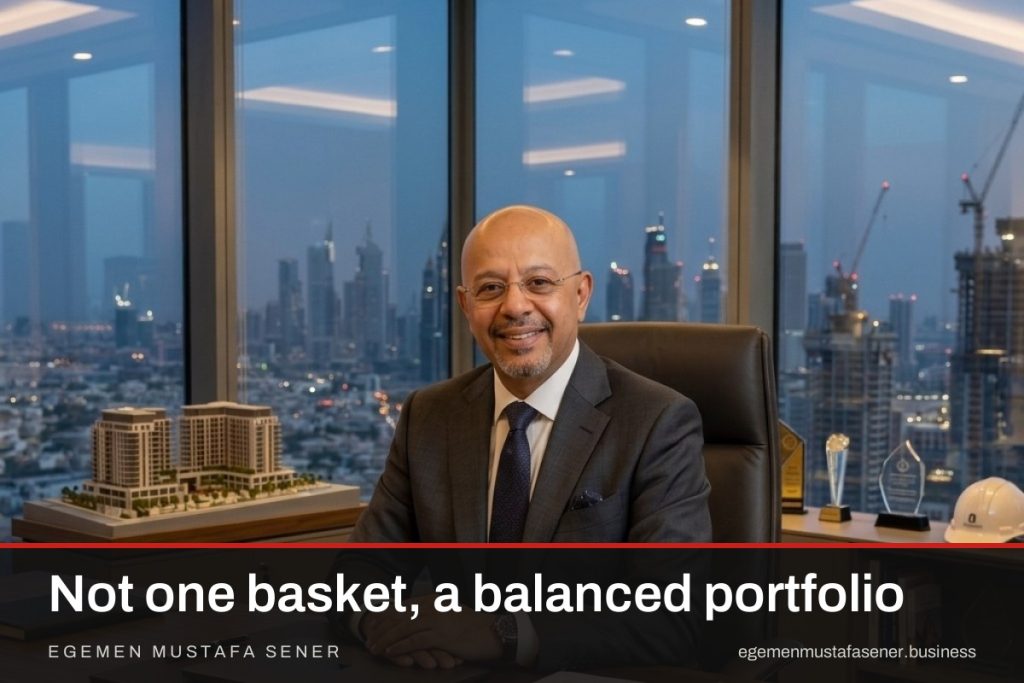
Real estate is a long-term investment field; but being tied to a single type or a single region can bind a portfolio to that field's cycle. Diversification is the basic way to reduce this dependence. Egemen Mustafa Sener's portfolio stands on five legs: homes, commercial property, industrial plants, infrastructure and renewable energy.
Dimensions of diversification
- Asset type: housing, offices, retail, warehousing, industry.
- Geography: different cities or countries.
- Income structure: sales, rental and operating income.
- Term: the balance between quick-return projects and long-haul investments.
- Stage: projects under development versus income-producing assets.
Why does it work?
- A slowdown in one sector is balanced by stability in another.
- Cash flow does not depend on a single source.
- Knowledge gained in one field improves the quality of decisions in other projects.
How do asset types complement each other?
Housing rests on a broad demand base and can bring quick returns through sales income. Commercial property offers a steadier income stream through leases. Industrial plants are tied to the production economy, infrastructure to long-term public needs. Renewable energy can create an income profile spread over many years through sales agreements. Held together, these fields with different cycles protect the portfolio against the ups and downs of a single market.
Points to watch
- A portfolio too scattered to manage is also a risk.
- Each new field calls for separate expertise and a team.
- In geographic diversification, local regulation and the choice of partner are decisive.
Diversification only makes sense when each field is well managed in its own right; otherwise it can multiply risk instead of spreading it.
How did Egemen Mustafa Sener's portfolio expand?
- Late 1980s: a working life that opened with trade in farm produce.
- Early 1990s: developing homes and commercial buildings in Istanbul, site and asset management.
- Late 1990s: industrial plants.
- 2000s: Turkey-centred renewal work and the development of infrastructure projects; the main body of the portfolio.
- 2010s: housing projects in Ukraine and Eastern Europe; ports, shipbuilding and logistics in South America.
- 2020s: selective investments in solar and wind.
This sequence shows that diversification was built not all at once, but through a gradual process in which experience in each field laid the ground for the next.
The principle
Egemen Mustafa Sener's approach of "Accumulate value, not money" makes diversification a yardstick not only for spreading risk but also for choosing fields that will create long-term value.
In short: diversification is not investing in everything; it is going deep in fields that balance one another.